What 3,800 Products Teach You That 30 Don't
Category trees are warehouse diagrams. Here is what actually changes when a WooCommerce catalog grows from thirty products to more than 3,800.
Or call or text (502) 387-1142




Websites I have built for Kentucky businesses


















The short answer
Almost every small online store inherits the same structure, and almost nobody chooses it on purpose. You install the platform, it gives you Categories, and you start filling them in: mugs, shirts, stickers, accessories. That is a warehouse diagram. It tells the person packing orders where things are kept, and it is close to useless for someone trying to buy a present for their father-in-law.
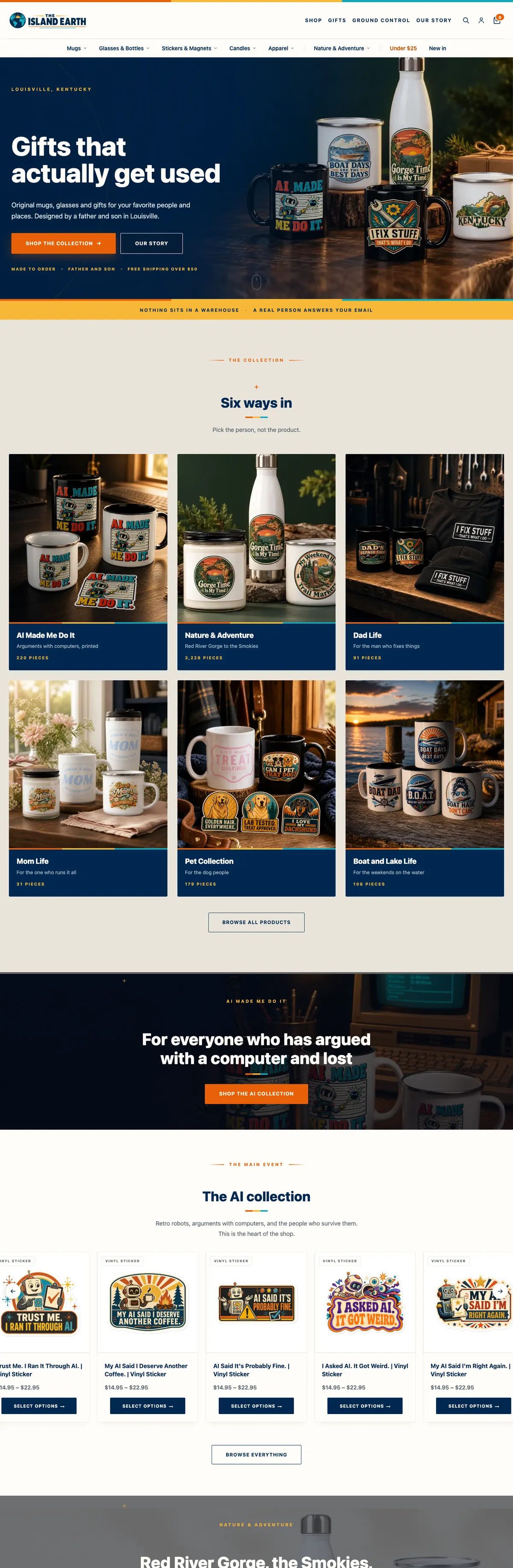
At thirty products you get away with it, because the customer can see everything on one page. At more than 3,800 you cannot. I run a large WooCommerce store, The Island Earth, and these are the six things that changed.
1. The category tree stops being navigation
At small scale, categories are how people browse. At large scale, almost nobody browses. They arrive from a search, land on one product, and either buy or leave. A carefully nested category tree becomes mostly something crawlers walk and customers ignore.
The fix is to organize by who a product is for, not what it is. The Island Earth’s top level is six collections built around people: Nature & Adventure, AI Made Me Do It, Pet Collection, Boat and Lake Life, Dad Life and Mom Life. A mug, a sticker and a shirt can sit in the same collection because they are for the same person, and that is what the visitor arrived with.
2. Overlap is a feature, and a duplicate content risk
Once collections are about people, products belong to several at once. A dachshund mug lives in Pet Collection and is also featured in the dachshund gift guide, and a Red River Gorge design sits in Nature & Adventure and in its own place hub. That is good merchandising and a real SEO hazard, because there are now several routes to the same product and the chance of several thin pages describing it.
What I do about it: one canonical home for each product, collections that link to it rather than copy it, and collection pages with their own real writing, so they are more than a filtered list under a heading. If a collection cannot justify a paragraph of its own, it should not be a page.
3. The sitemap becomes an operational system
At thirty products nobody looks at the sitemap. At more than 3,800 it is the only way to know the catalog is still intact. The Island Earth’s runs to nearly 4,000 URLs across products, collections, place hubs, editorial and pages, and it gets checked, because a silent failure there means whole sections stop being indexed while the front end looks exactly the same.
The useful habit is counting. Know how many product URLs you expect. When the number changes and you did not change anything, something broke.
4. One image rule, applied 3,800 times
Consistency at scale is not a design problem, it is a rules problem. Thirty products can each get a considered photograph. More than 3,800 cannot, and the moment individual decisions creep in, the grid looks like four different shops.
So the rule gets written down instead: the crop, the background, the margin, where the product sits in the frame and what the first image always shows. Then it is applied mechanically. The rule is worth more than any single image, because the rule is what makes the grid look deliberate.
5. Editorial is not a blog
A blog is what a store adds because someone said it should have one. Editorial exists to catch the searches that happen before a buyer knows what they want. Product pages answer “where do I buy this exact thing”, a small number of searches with high intent. Editorial answers “what do I get for a dad who says he wants nothing”, a very large number of searches that no product page will ever rank for.
On The Island Earth that layer is Ground Control: gift guides, occasions and trail and travel pieces that point into the collections. If you compete with marketplaces on product terms alone, you lose. The editorial layer is where a small store is actually allowed to win.
6. What I would do differently
Three things, honestly.
- Write the image rule before the first product, not the hundredth. Retrofitting consistency across a live catalog is far more work than starting with it.
- Decide the collection structure before uploading anything. Products are easy to add, and structural decisions are expensive to reverse once thousands of things depend on them.
- Set up measurement first. It is easy to build a large store and discover months later that you cannot tell which collection actually sells, because nothing was tracked from the start. Analytics is a foundation task, not a launch task.
The short version
Small catalogs forgive bad structure because customers can see everything. Large catalogs forgive nothing. Every weak decision is multiplied by the number of products, and the only defense is deciding the rules before the volume arrives.
The whole build is written up in the Island Earth WooCommerce case study, with the collections, the place hubs and Ground Control laid out. If your own store is big enough to feel this, it is the work I do as a WooCommerce developer, and the print partner connection is one of my integrations.
Frequently asked questions
How should a large WooCommerce store be organized?
Around the people buying rather than the product types. Collections built for a person, such as a dad, a dog owner or a hiker, match how visitors arrive, and a product can sit in more than one.
Do overlapping collections cause duplicate content?
They can. Give every product one canonical page, have collections link to it rather than copy it, and give each collection page its own written introduction.
How do I know if my store’s sitemap is healthy?
Know how many product URLs you expect and count them regularly. If the number changes when you did not change anything, something is broken.
When should analytics be set up on a new store?
Before launch. If tracking is added later, there is no history to tell you which collections sell.
Talk it through with me.
If your catalog is outgrowing its structure, tell me what is going on. You get a straight answer on what to fix first.
More from the studio: The Island Earth WooCommerce case study, WooCommerce developer, E-commerce websites, Integrations, SEO services, Web design in Louisville.