
Insurance adjuster website design that earns the assignment.
A claims manager deciding who gets a file wants to know three things fast: what kinds of losses you handle, where you work, and who will actually be on the file. I build websites for adjusting firms that answer those questions plainly and make the first conversation easy to start.
Or call or text (502) 387-1142
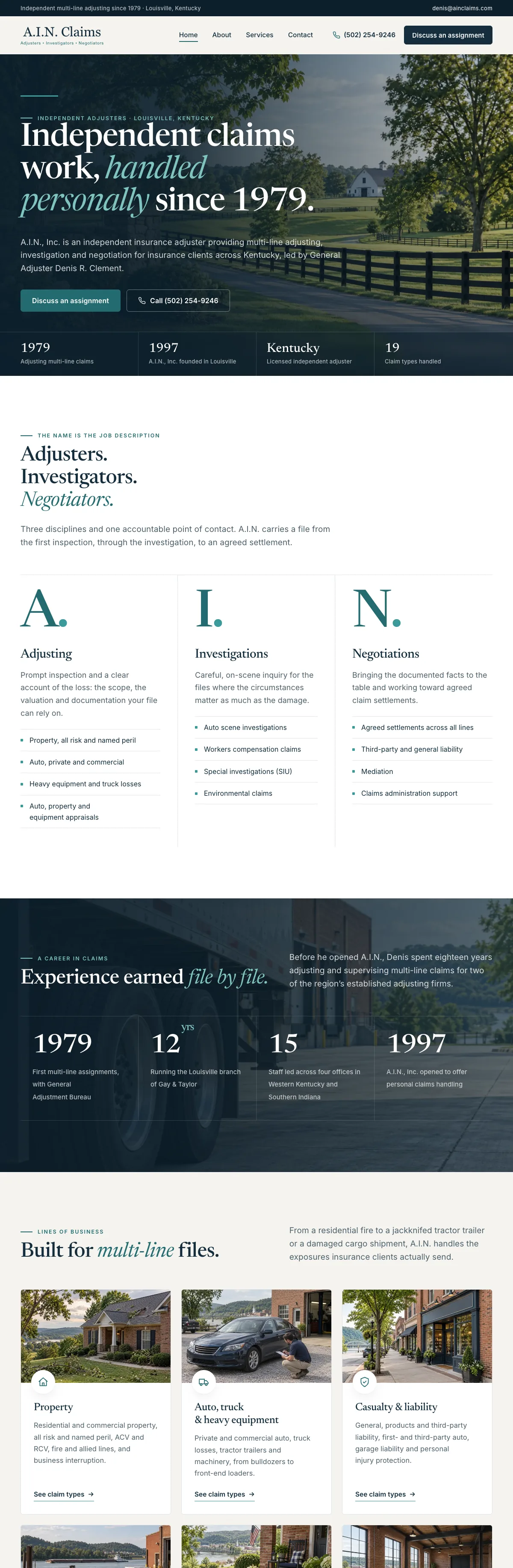

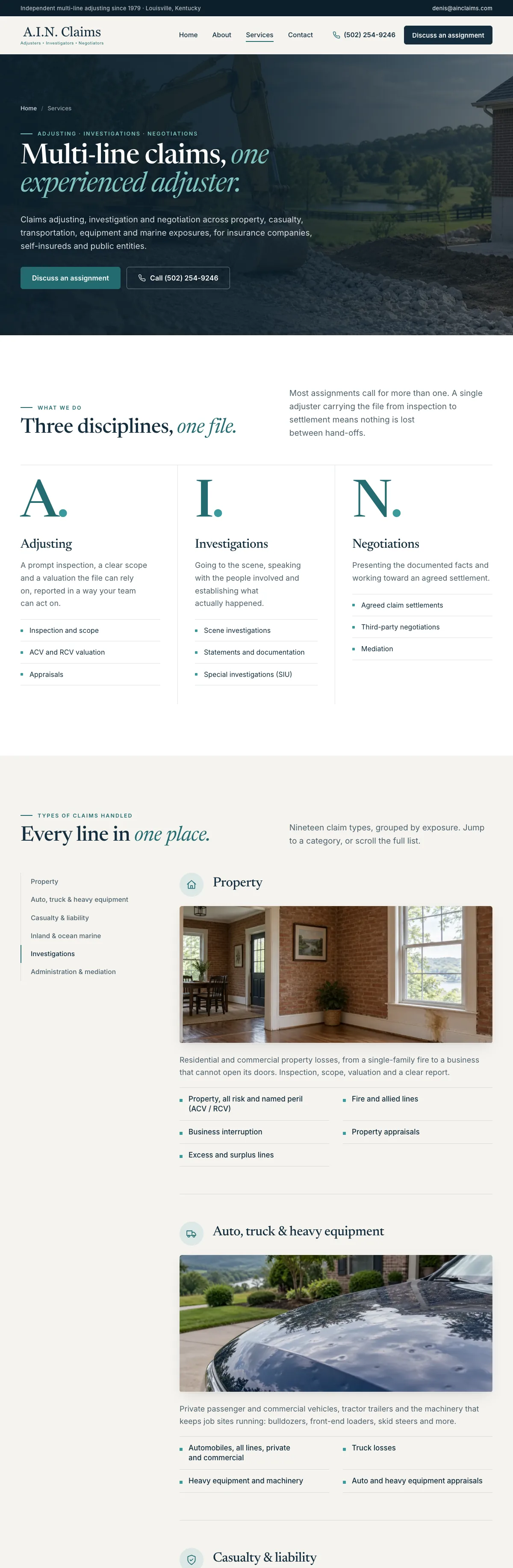

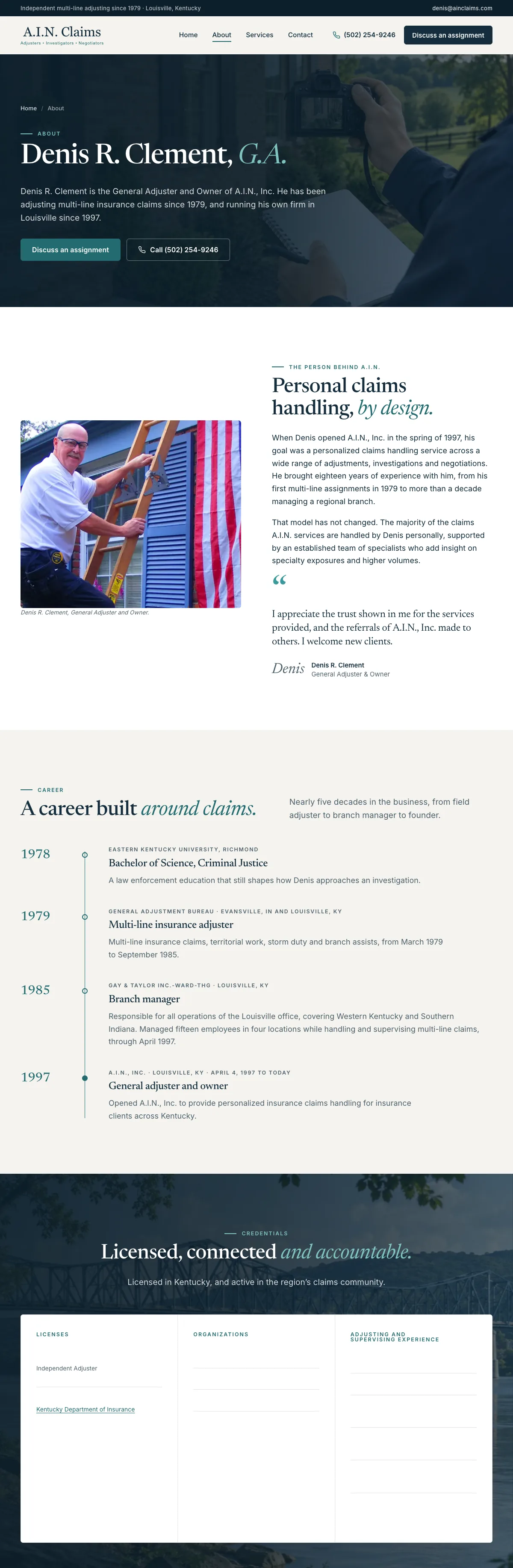
Websites I have built for Kentucky businesses



















Your website is read by the people who assign the work.
An adjusting firm’s best visitors are rarely in a hurry to buy. They are claims professionals, risk managers and program administrators checking whether you handle their kind of loss in their territory, and whether the person behind the firm has the experience the file needs.
A generic small business template does not help them. A good adjuster website says who you work for, organizes a long list of claim types so it can be scanned, puts the adjuster’s background in plain view, and gives a clear first step that never asks for sensitive claim details on a public form.
Insurance adjuster website design: six things the site has to do.
Say who you work for
Independent adjusters are hired by insurance companies and self-insured organizations. Public adjusters represent policyholders. The site says which you are in the first screen, and points the wrong visitor somewhere useful instead of taking a call you cannot help with.
Claim types that scan quickly
Property, auto and heavy equipment, casualty and liability, marine, investigations, appraisal or mediation: grouped, briefly explained, with an index that jumps straight to the right section. Nobody should read about cargo to find hail.
Adjuster bios with real history
Years in the field, designations, the kinds of files handled and a real photograph. A career timeline helps, as long as old roles and old territories are clearly history and never read as today’s coverage.
Licenses and territory, stated plainly
Adjusters are licensed state by state, so list the states you hold licenses in and keep that list current. Coverage copy should match those licenses exactly; one outdated state on a page becomes an awkward question from a client.
A first inquiry that stays safe
Contact details, company, the assistance needed, location and a short overview. The form tells people not to send policy numbers, Social Security numbers, medical or banking details, and explains how documents will be exchanged once the file is accepted.
A site that stays accurate
Titles, descriptions, structured data and a sitemap at launch, then managed updates, backups and checks so the site does not quietly fall behind the firm. Coverage and staff changes are one message away.
A.I.N. Claims: a Louisville adjuster since 1979.
A.I.N., Inc. is Denis R. Clement’s independent adjusting firm in Louisville. He began adjusting multi-line claims in 1979, opened A.I.N. in 1997, and serves insurance companies, excess and surplus lines writers, self-insured organizations and public entities across Kentucky.
I rebuilt the site around that experience: six service groups with an in-page category index, an owner page with a career timeline, and a short inquiry that asks for the assistance needed and the assignment location, with guidance to leave sensitive details out. It launched on 10-15-2026.

What a claims firm’s website should get right.
Independent or public, say it early
The words “insurance adjuster” cover people on opposite sides of a claim. A carrier’s claims manager looking for field help and a homeowner looking for someone to fight their insurer can land on the same page. State who you represent near the top, and give the other visitor a polite next step, such as contacting their own insurer or agent, so your phone line stays for the work you actually take.
Organize by loss, then by detail
Most adjusting firms handle more claim types than a visitor wants to read. Group them the way your clients think about exposures, give each group a short plain description, then list specific examples underneath. A category index at the top of the services page does more for a busy reader than a long scrolling list.
Keep the first form small and safe
A public web form is the wrong place for claim files. Ask only what you need to decide whether to talk: who is asking, what kind of help, where, and a short overview. Say clearly what not to send, skip the upload field, and explain how reports, photographs and documents will be exchanged once an assignment is agreed. If a full document portal is ever needed, it should be a separate, properly secured system, not a contact form.
Let the experience show without overselling
Claims clients trust specifics: the year someone started adjusting, the kinds of files handled, designations held and the territory served today. They distrust promises nobody can keep, so avoid guaranteed outcomes and response times the office cannot meet. If an older site has drifted out of date, a website redesign is the moment to put that right.
Four steps from first call to launch.
Talk through an assignment
How a file reaches you, who decides, and what they need to see before they pick up the phone.
Sort the services
Your claim types grouped the way your clients think, with plain descriptions you check for accuracy.
Write the people and territory
Adjuster bios, licensing and current coverage, with history kept clearly separate from today.
Build, check and launch
The inquiry form, page titles, structured data and sitemap, checked on desktop and phone before it goes live.
What I will tell you before you hire me.
My adjuster proof is one firm
A.I.N. Claims is the adjusting firm on my portfolio today. The advice on this page comes from that build and from how claims work is assigned, and I will ask you to check every detail against how your firm runs.
A website is not a claim system
I build the public site and a safe first inquiry. Claim files, reports and documents belong in the systems you and your clients already use, not on a marketing website.
Only claim what is current
Licenses, territories, designations and staff change. If a fact is not current, it comes off the site. I would rather leave a line out than publish something a client could question.
What claims firms ask first.
What is the difference between an independent adjuster and a public adjuster website?
An independent adjuster works for insurance companies and self-insured organizations, so the site speaks to claims professionals. A public adjuster represents policyholders, so the site speaks to people with a loss. The structure is similar, but the audience, wording and inquiry questions are different, and the site should make clear which one you are.
Should my website list my adjuster license numbers?
List the states you are licensed in and keep the list current. Whether to show license numbers depends on your states and your clients’ expectations; I put them wherever you want them, usually on the about page and in the footer.
Can clients upload claim documents through the website?
I recommend against it on the first contact form. The inquiry asks only what you need to start a conversation and tells people not to send sensitive details. Documents are exchanged the way you and the client agree once an assignment is accepted.
Do you write the content?
Yes. I write the pages from a conversation with you and from your existing materials, then you check every claim type, date and territory before anything goes live.
Can you work with a firm outside Kentucky?
Yes. I am based in Louisville, Kentucky, and I build websites for businesses anywhere. The process is calls, a shared outline and a preview site you review before launch.
What does an insurance adjuster website cost?
It depends on how many services, adjusters and locations the site needs to cover. After one conversation you get a fixed written quote and a timeline.
Tell me how an assignment reaches your firm.
Walk me through who sends you files and what they check first. I will show you what the website should say at each step, then put it in a written scope.
Connect with me
Tell me about your adjusting firm.
What happens next
- 01I reply, usually the same day. Every message comes straight to me, not a ticket queue.
- 02A short call. What the site needs to do, who it is for, and what has not worked before.
- 03A written scope and flat quote. Before any work starts, with hosting and ongoing care listed separately.
5.0 on Google · 29 reviews · I usually reply the same day