Lucas Play: an ecommerce website rebuilt from an old store, with all 1,374 products moved.
Lucas Play sells toys, LEGO sets, vintage action figures, trading cards, video games and signed collectibles online. The catalog lived on an older WooCommerce store that had grown to 1,374 listings. I extracted every product, photo and category from it, rebuilt the shop from scratch around browsing and discovery, and launched it at lucasplay.com on October 10, 2026.
Or call (502) 387-1142Or text (502) 387-1142Lucas Play, toys, LEGO, trading cards and collectibles
Kentucky, shipping across the United States
Ecommerce rebuild: full catalog migration, new storefront, product copy and SEO on every listing
WordPress and WooCommerce, live October 10, 2026
Keep every product. Replace everything around them.
The old store had the hard part done: years of listings, each with photos, a price and a category. What it lacked was a shopping experience. Collectors arrive looking for a specific LEGO set, a 1980s G.I. Joe figure or a Pokemon card, and a long grid of mostly sold items does not help them find it.
So the brief was simple to say and big to do. Move every product, photo and category without losing anything, then build a storefront that makes 1,374 pieces enjoyable to explore: available pieces first, clear paths by collection and by decade, honest product details, and a way to ask for the piece that is not in stock yet.
The identity is warm and playful: a cream background, navy type, coral accents and a colorful Lucas Play wordmark, with large product imagery and rounded cards that keep a big catalog from feeling like a warehouse.
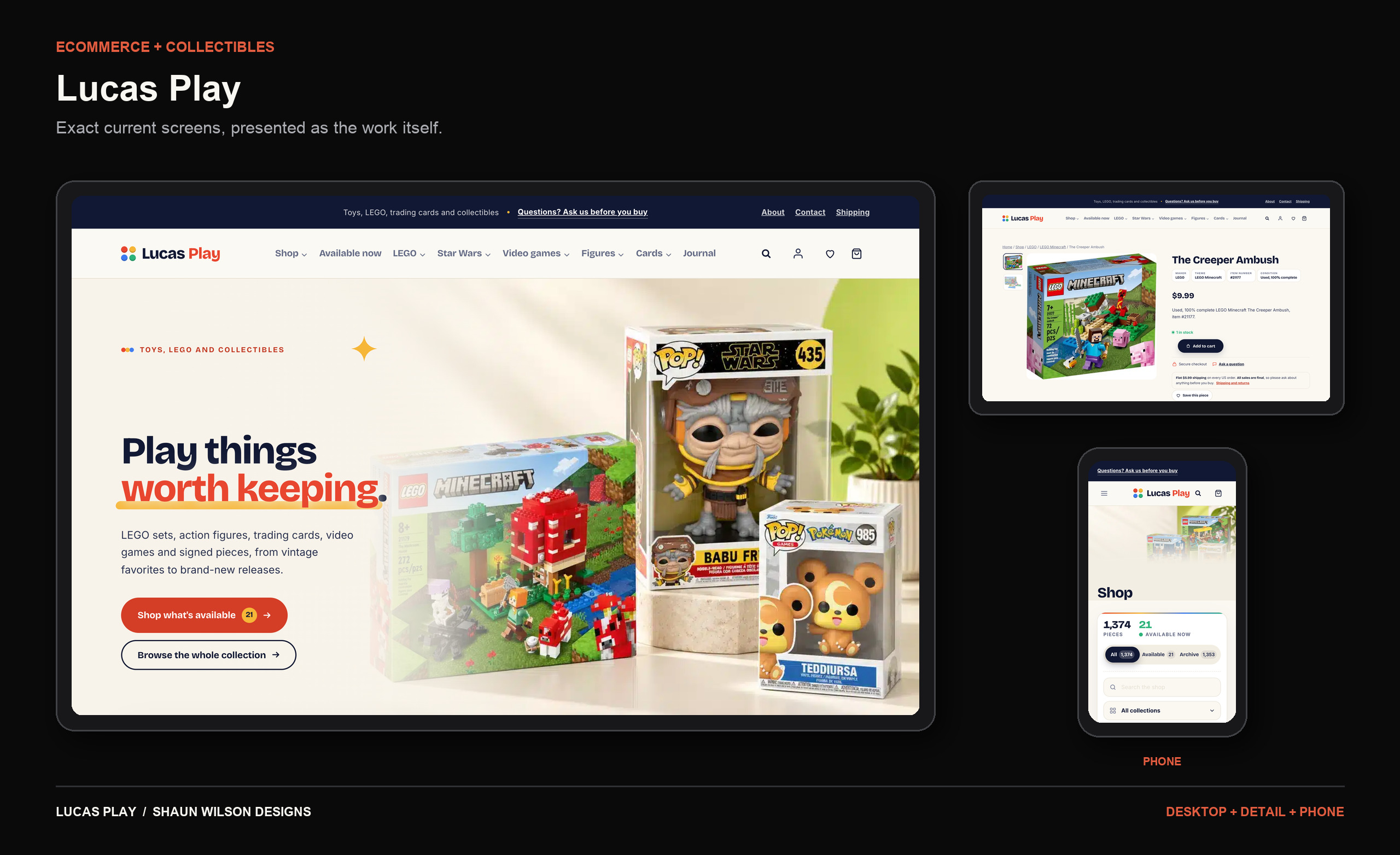
Exact screens, not mockups.
Direct browser captures of the live site at 1440 pixels. Nothing redrawn, nothing staged.

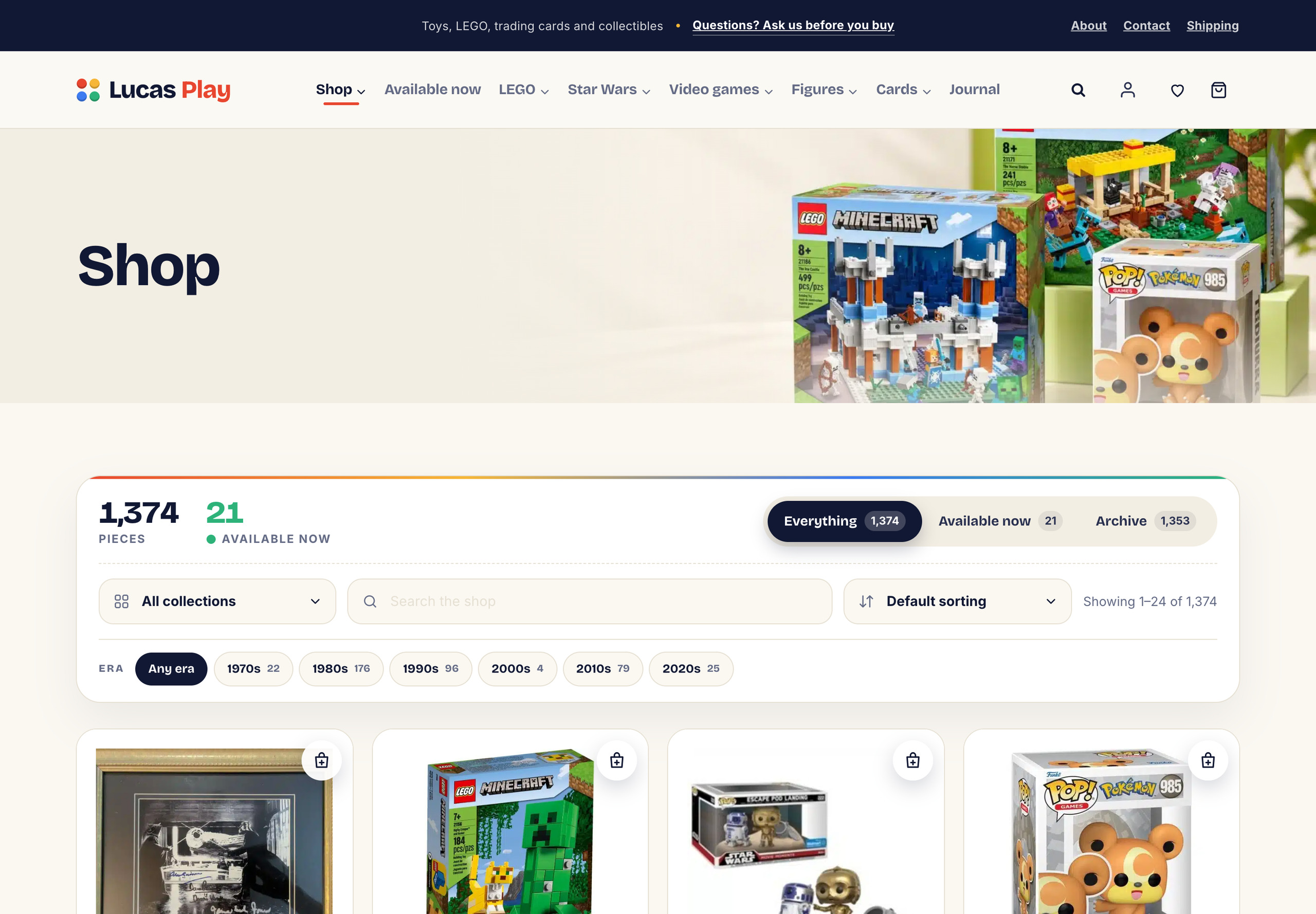
The work, piece by piece.
A complete catalog migration
1,374 products, 1,763 photos, 60 categories, 70 tags and 20 brands moved from the old store, with names, prices, descriptions, stock status and category hierarchy intact.
Copy and SEO on every listing
Each description rewritten and checked against the original listing with nothing invented, plus an SEO title, meta description and photo alt text on every product.
Available first, archive kept
Pieces in stock always sort first. Sold pieces stay in a browsable collection archive with a path to ask about one like it.
Shop by decade
Era pages from the 1970s to today, plus an era filter on the shop and every collection, so a collector can browse the 1980s on their own.
Product pages that answer questions
A large photo gallery, a details card with maker, line, year, item number and condition, and related pieces with available ones first.
A want list and a journal
Collectors describe the piece they are hunting for, and a journal of gift guides and collecting notes gives the store something to say between sales.
Built for every screen it will meet.
1,374
products moved from the old store, none left behind
1,763
product photos carried over at full size, alt text on every one
730
product photos cleaned onto white backgrounds, nothing repainted
1,486
URLs crawled before launch, every one answering
A large catalog that is enjoyable to browse, and easy for the owner to run.
Lucas Play launched with its whole history intact and a storefront built around how collectors actually shop: what is available today, what came from a decade they love, what one piece really is, and how to ask for the one that got away. The owner can add pieces, mark them sold, write journal posts and edit the homepage without calling a developer.
This page describes the website as built and launched. It does not claim sales, traffic or ranking figures.
Every product moved. Every page rebuilt. Every listing rewritten.
An ecommerce rebuild that keeps the catalog and replaces everything around it.
Six decisions that shaped the store.

Extract everything, lose nothing.
The old store was a WooCommerce shop, and its public product data was enough to rebuild from without waiting on an export: names, prices, sale prices, descriptions, categories, tags, brands, weights, stock status and every full-size image.
An importer copied all of it in batches and keyed each product to its original listing, so it could be re-run safely and checked afterward. Then the counts were reconciled: 1,374 products in, 1,374 products out, every one with a photo, a price and a category.
Put the piece first.
Each product page leads with a large gallery and a details card: maker, line or theme, year, item number, platform and condition, filled from each listing’s own facts for 1,124 products. The description sits beside the photos, followed by related pieces with available ones first.
On a phone, a sticky buy bar follows the shopper down the page. Shipping is a flat $5.99 on every US order, said plainly on the product page.


What you can take home today, up front.
Most of the old catalog had already sold. Rather than hide that history, the store sorts every listing with available pieces first and marks sold ones clearly. The homepage opens with an Available now row and a count of what is in stock.
Collections and menus show piece counts and the newest in-stock arrivals, so a visitor always knows what is real and ready to ship.
A sold piece still earns its place.
A sold product keeps its page, photos and description as part of the collection archive. Instead of a dead end, it says the piece has found a home and offers two next steps: add it to the want list, or see what is available now.
That turns 1,353 sold listings from clutter into a catalog of what the store carries, and a reason for a collector to get in touch.


The 1980s, on their own page.
Collectors think in decades. Each era has its own page with its own counts, from the 1970s to the 2020s, and an era row on the shop and every collection narrows any category to a decade in one tap.
The decade comes from each product’s year, so when the owner adds a new vintage piece it files itself.
Tell us the piece you are hunting for.
The want list gives collectors a short form for the piece they are after: character, year, set number, condition and budget. When a matching piece is listed later, the store checks it against recent requests and alerts the owner, so a sale can start with a message instead of a search.
Next to it, the journal publishes gift guides and collector notes, with links into the collections each one covers.

A collectible store in a hand.
Before launch: every sitemap URL answered, 1,307 internal links checked with none broken, no accessibility violations on 16 key pages and no sideways scrolling on 23 page types at three widths.


What store owners ask before a rebuild.
Can you move my existing store without losing products?
Yes. Lucas Play moved all 1,374 products, 1,763 photos and every category from its old store. Each product is keyed to its original listing, and the counts are reconciled before launch. The full method is in the WooCommerce migration guide.
Do I need to give you a login to the old store?
It helps, but it is not always required. A WooCommerce store publishes enough product data to rebuild the catalog. A login or export adds exact stock counts, hidden products and order history.
What about all my sold items?
Your call. Lucas Play keeps them as a collection archive with a path to ask about one like it. Some stores hide them. Either way, nothing is deleted.
Can I run the store myself afterward?
Yes. Adding a piece, marking it sold, writing a post and editing the homepage all happen in WordPress, and the store has a built-in guide for each task.
Do you build ecommerce websites outside Louisville?
Yes. I build from Louisville for stores across Kentucky, Southern Indiana and the rest of the country. Ecommerce does not care where the server sits.


What this project used.
Ecommerce website design
Storefronts built around how your customers shop, from a few dozen products to thousands.
WooCommerce development
Catalog migration, custom sorting and archives, era filters, want-list matching and owner tools.
Website redesign
Rebuilding a store that has outgrown its old site, without losing a product or a photo.
Ecommerce website design, built in Louisville.
Shaun Wilson Designs builds online stores from a studio in Louisville, Kentucky: ecommerce website design, WooCommerce development and store rebuilds like this one. For a print-on-demand example, see The Island Earth. Every screenshot on this page is a direct capture of the live site. The device scene at the top is a presentation setting built around the real homepage capture.
Tell me what you are building.
One conversation, one builder, a clear next step. The person you brief is the person who does the work.